The Workforce Redesign Playbook

Executive Summary: The Efficiency Paradox
Telecommunications and Internet Service Providers (ISPs) operate at the center of an efficiency paradox. They face relentless pressure to reduce operational expenditures (OpEx) while simultaneously delivering higher levels of customer satisfaction (CSAT) in a fiercely competitive market.
The traditional model for managing customer contact — scaling human agent capacity in response to demand — is no longer viable. This approach breaks under the strain of predictable and unpredictable volume spikes, such as those driven by service outages or new product launches, leading to extended wait times, diminished service quality, and customer churn.
The solution is not to simply reduce headcount but to fundamentally redesign the work itself. This playbook presents a methodology for strategically re-architecting workflows to protect and enhance customer outcomes, strengthen operational controls, and preserve a resilient organizational culture.
The core of this approach is the introduction of Tier-Zero Support, a framework where autonomous agents handle the high-volume, low-complexity tasks that constitute up to 70% of contact center traffic. This frees human agents to focus on the complex, high-value interactions that directly impact customer loyalty and retention.
This whitepaper provides a blueprint for this transformation, structured around three critical pillars: protecting customer outcomes, establishing robust controls, and preserving culture. It offers a clear, data-driven case for redesign, a practical implementation roadmap, and a vision for a hybrid workforce where technology and human expertise are applied to their highest and best use.
By shifting the focus from managing human resources to optimizing workflows, organizations can resolve the efficiency paradox, turning their customer service operations from a cost center into a strategic asset for durable growth.
The Structural Crisis in Telecommunications Customer Service
The operational model for customer service in the telecommunications sector is structurally constrained. Decades of investment in Operations Support Systems (OSS) and Business Support Systems (BSS) have created a sprawling, complex, and often brittle technology landscape .
While essential for network management and billing, these legacy systems were not designed for the agile, real-time, and personalized interactions that customers now expect. The result is a high-friction environment where simple customer inquiries — password resets, modem status checks, billing clarifications — become costly, multi-step processes requiring significant human intervention.
The Economics of Unsustainability
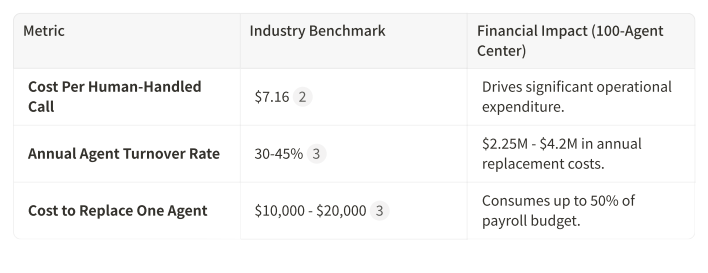
This model is unsustainable for two primary reasons: its economics are inverted, and its workforce model is fundamentally broken. The average cost of a single human-handled inbound call is now estimated at $7.16, a figure that stands in stark contrast to the sub-dollar cost of a fully automated interaction .
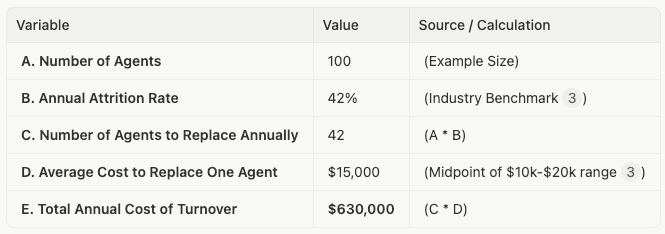
This cost is magnified by the operational realities of the contact center, where high-volume, repetitive tasks are the primary drivers of both operational expenditure and employee attrition. The industry is grappling with an agent turnover crisis, with average annual rates between 30% and 45%, and in some segments, as high as 60% . The cost to replace a single agent can range from $10,000 to $20,000 in direct costs alone, translating to millions of dollars in annual losses for a mid-sized contact center and consuming up to 50% of its payroll budget .
The Workforce Burnout Cycle
This constant churn is a direct consequence of a system that treats human agents as a fungible resource for managing predictable, low-value demand. The primary driver for agent departure is burnout, fueled by the relentless pressure of high-pressure metrics and constant exposure to frustrated customers .
The model fails its employees, and it fails the business during moments of truth. During service outages or other peak events, the “add heads” strategy collapses, leading to overwhelmed queues, plummeting customer satisfaction, and a surge in customer churn. The core message is clear: the unit of change is not the organizational chart, but the workflow itself.
A strategic redesign is a necessity because the complexity of legacy infrastructure is not shrinking, and customer expectations for seamless, effective service are not diminishing.
Redefining Customer Outcomes in an Automated World
The adoption of automation in customer-facing roles is often met with significant apprehension, centered on a valid and critical concern: that the pursuit of efficiency will degrade the customer experience, making it feel cold, incorrect, or needlessly complex.
The central challenge, however, is not the existence of automation, but its implementation. When automation is layered onto flawed processes, it tends to amplify their deficiencies. The goal of a successful workforce redesign, therefore, is not to simply deflect contact or minimize interaction time, but to enhance the quality and durability of the outcomes delivered.
Beyond Deflection: What Customers Actually Need
For years, the industry has been focused on “channel shift” and “call deflection” as primary goals for digital transformation. This approach is fundamentally flawed because it mistakes a reduction in a single channel’s volume for a genuine reduction in customer effort.
A customer who fails to resolve an issue via a chatbot and is then forced to call is not a success story; it is a service failure that has now spanned two channels, increasing both customer frustration and operational cost.
To achieve this, customer outcomes must be defined in precise, operational terms:
- Was the issue fully resolved on the first attempt?
- Was the customer’s effort minimized?
- Was a clear explanation provided?
- And is there a clear, accessible path to recourse if the system fails? These are the metrics that define a successful interaction, and they stand in stark contrast to the logic of legacy systems.
Static Interactive Voice Response (IVR) menus, which force customers to navigate a rigid, impersonal decision tree, are a primary driver of customer frustration, particularly for those with complex issues or those making repeat contacts during a service disruption.
Contextual Intelligence as the Foundation
The alternative is a model built on Contextual Intelligence. Instead of treating every call as a new, isolated event, an intelligent system knows who is calling, what services they have, and what recent events — such as a localized network outage or a recent billing cycle — might explain the reason for their contact.
This allows the autonomous agent to move from a generic greeting to a specific, proactive statement, such as,
“Hello John, I see your modem is offline. Let me check the network status in your area.”
This single step transforms the interaction from an interrogation into a consultation, immediately reducing customer effort and demonstrating a grasp of the situation.
Measurement That Matters for Customer
This shift in approach necessitates a corresponding shift in measurement. For decades, contact centers have been managed by the metric of Average Handle Time (AHT), a measure of throughput that can inadvertently reward premature call termination and incomplete resolutions.
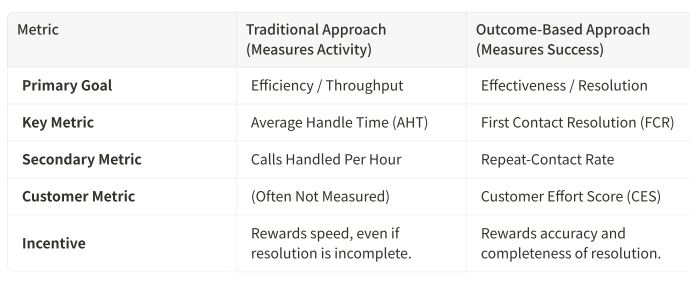
First Contact Resolution (FCR) and the repeat-contact rate provide a clear, unambiguous signal as to whether the customer’s issue was resolved effectively. A high FCR rate is a direct indicator of a well-functioning system, and a low repeat-contact rate proves that the experience was not only efficient but durable.
Furthermore, the Customer Effort Score (CES) has emerged as a powerful predictor of customer loyalty. By asking a simple question —
“How much effort did you personally have to put forth to handle your request?”
Ultimately, automation earns customer trust only when it demonstrably reduces the need for that customer to exert further effort to achieve their desired outcomes.
The Control Architecture: Making Automation Auditable
For telecommunications firms and ISPs, the deployment of any new technology is governed by a strict set of regulatory, privacy, and audit obligations. The integration of autonomous agents into customer-facing workflows is no exception.
Control is not an optional feature; it is a fundamental design requirement. In a properly architected system, controls are not promises but testable, auditable, and deeply embedded design choices. This should be read not as a feature list, but as a risk brief on how to ensure that automation operates safely and predictably within established boundaries.
Machine-Enforceable Guardrails
Effective governance of autonomous systems begins with translating high-level policies into specific, machine-enforceable rules. These are not suggestions; they are immutable constraints on the agent's behavior. This requires a multi-layered approach to control:
Fine-Grained Permissioning:
The system must enforce exactly what actions an autonomous agent is authorized to perform. This goes beyond simple role-based access, defining permissions at the level of individual API calls and data fields. For example, an agent may be permitted to read a customer's billing history but not modify it, or it may be authorized to apply a pre-approved discount code but not an arbitrary credit.
Comprehensive Logging:
The system must create an immutable, human-readable audit trail of every decision and action the agent takes. This includes not only the final action but the data points and logical steps that led to it. This level of transparency is essential for forensic analysis, dispute resolution, and regulatory reporting.
Systematic Masking of Personally Identifiable Information (PII):
The architecture must ensure that sensitive customer data is systematically masked and protected throughout its lifecycle, both from unauthorized internal access and from being inadvertently exposed in logs or transcripts.
Pre-Approved Action Libraries:
The agent's ability to act must be constrained to a library of pre-approved, rigorously tested workflows. This prevents the system from operating outside of its designated scope and ensures that every action it takes has been vetted by legal, compliance, and operational stakeholders.
These guardrails must be tangible and explicit. The system must be architected to know what it is allowed to do, what it is forbidden from doing, and, most critically, when it must escalate to a human operator.
Confidence-Based Routing and the Human-in-the-Loop
No automated system can or should handle every interaction. The most critical control is knowing when to stop and escalate to a human. This escalation pathway is managed through a mechanism known as confidence-based routing. For each potential action or decision, the autonomous agent calculates a confidence score based on the quality of the available data, the clarity of the customer’s intent, and the historical success rate of similar interactions. This score is then compared against a predefined and tunable threshold.
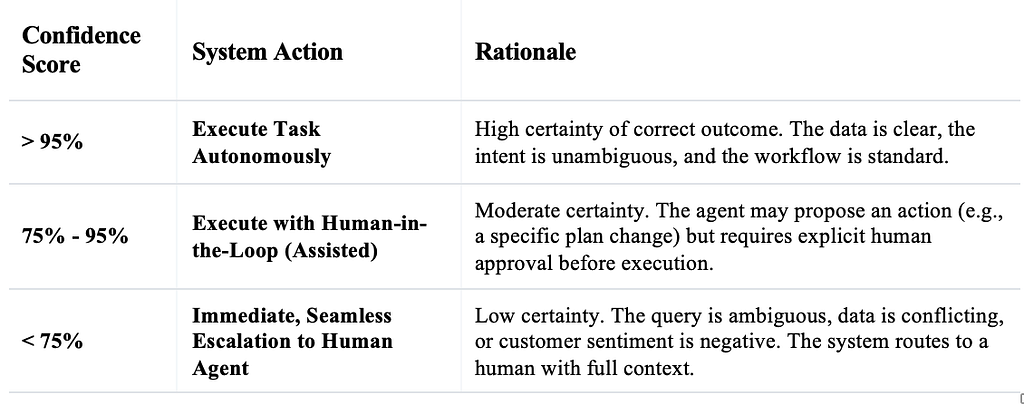
This “escape hatch” is a critical safety feature, but it must be designed as a proactive measure for customer and risk protection, not as a reactive fallback for poor performance.
The handoff to the human agent includes the full transcript and context of the interaction, ensuring the customer does not have to repeat themselves and empowering the agent to resolve the issue efficiently.
Workflow Change Control
Finally, in a regulated environment, the automated workflows themselves must be subject to the same rigorous change control processes as network infrastructure or billing systems. This requires a governance framework that supports:
- Versioning: Every change to a workflow is tracked as a new version.
- Approvals: Modifications require sign-off from designated business, technical, and compliance owners.
- Rollback Plans: A faulty workflow can be instantly reverted to a previous stable state.
This ensures that control is not a one-time implementation but a continuous operating discipline that can be consistently verified and audited. It is this demonstrable control that provides the foundation for trusted, scalable automation.
Protecting Culture Through Job Architecture
A common misconception is that automating repetitive tasks will organically lead to more fulfilling work for human agents. The operational reality is often the opposite.
Without a deliberate redesign of roles and responsibilities, the human workforce inherits a workflow composed exclusively of angry escalations and complex, frustrating edge cases. This dynamic does not alleviate burnout; it concentrates it, accelerating attrition and undermining the very stability the redesign is meant to create. Protecting an organization’s culture, therefore, is not a matter of slogans or internal marketing. It is a direct function of job architecture and the intentional distribution of work.
From Call Center Agents to Customer Success Specialists
The fundamental shift required is from a workforce of “Call Center Agents,” tasked with processing queues and adhering to rigid scripts, to a team of “Customer Success Specialists,” empowered to solve complex problems, exercise judgment, and preserve high-value customer relationships. This is more than a change in title; it is a fundamental change in the nature and value of the work itself. As autonomous agents absorb the high-volume, low-complexity tasks that are the primary source of agent burnout, the human role elevates to focus on work that only humans can do effectively:
- Complex Exception Handling: Investigating and resolving issues that fall outside the boundaries of standard, automated workflows.
- High-Value Retention Saves: Engaging with at-risk customers to understand their frustrations, address their concerns, and rebuild the relationship.
- Advanced Technical Troubleshooting: Diagnosing and resolving complex connectivity, provisioning, or service quality issues that require deep product knowledge and diagnostic reasoning.
- Proactive Customer Outreach: Contacting customers about potential service improvements, personalized offers, or to follow up on previously resolved complex issues.
This model transforms the contact center from a reactive cost center, measured by its ability to handle volume cheaply, into a proactive engine for customer loyalty and lifetime value, measured by its ability to retain and grow the customer base.
The Economics of Reinvestment
For this transformation to be successful, several conditions must be met. The budget saved through automation cannot simply vanish into general operating funds.
A significant portion must be reinvested into the human workforce, funding higher pay bands that reflect the increased skill level, comprehensive training programs that build diagnostic and problem-solving capabilities, and protected time for coaching and quality review. This reinvestment is what makes the new operating model stable and proves to the workforce that redesign is a path to advancement, not a precursor to replacement.

The Ethical Choice is Operational
The ethical choice is therefore an operational one. The most effective way to preserve culture is to upgrade the work itself, ensuring that human agents are focused on the tasks that require judgment, empathy, and complex problem-solving — the very tasks that machines cannot perform.
The message to the organization must be clear and backed by investment:
Let the AI be the robot, so your humans can be human.
The Implementation Roadmap: From Pilot to Transformation
A successful workforce redesign is not a single, monolithic event but a phased, deliberate progression.
A “big bang” approach, which attempts to transform all workflows simultaneously, is fraught with risk and likely to be rejected by the organization. A more effective strategy is a practical maturity model that incrementally builds confidence, demonstrates value, and proves the reliability of controls at each stage.
This roadmap is designed to reduce fear and manage complexity, sequencing the rollout from safe, high-confidence gains to a full operational transformation.
Phase 1: The Filter (Target: 10% of call volume)
The initial phase focuses on safe, high-value gains that do not require deep integration into complex backend systems. The primary goal is to build organizational confidence, instrument the measurement of key outcomes, and prove the effectiveness of the control framework.
Workflows in this phase are typically limited to:
- Identity and Verification (ID&V): Automating the initial, time-consuming process of verifying a caller’s identity.
- Simple Status Inquiries: Providing automated updates for common questions like, “Is there an outage in my area?” or “What is my current balance?”
- Structured Triage: Intelligently routing inbound calls to the correct human queue based on the caller’s stated intent, bypassing complex IVR menus.
These tasks are characterized by their low risk and high frequency, providing a rich dataset for validating the performance of the autonomous agents and the security of the control architecture. The success of this phase is measured not by the total volume automated, but by the accuracy of the outcomes and the stability of the platform.
Phase 2: The Transaction (Target: 40% of call volume)
Once the core platform has proven its stability and reliability, the second phase expands the scope to include full, end-to-end transactional workflows. These are processes with tight, well-defined boundaries that can be fully automated with direct API integration into OSS/BSS systems. Each transactional workflow must be deployed with a clear set of acceptance criteria, not just a deployment date. This ensures that the automation is not only functional but also meets the required standards for accuracy, security, and customer satisfaction.
Examples include:
- Processing a Bill Payment
- Making a Validated Change to a Service Plan
- Scheduling or Rescheduling a Technician Appointment
- Guiding a Customer Through a Modem or Set-Top Box Reset
This phase delivers a significant and measurable reduction in the volume of routine tasks handled by human agents, freeing up substantial capacity for the newly formed Customer Success Specialist teams
Phase 3: The Transformation (Target: 70%+ of call volume)
The final phase marks the shift from automating discrete tasks to transforming the operating model itself. In this stage, autonomous agents handle the majority of routine contact volume, with human agents focused exclusively on managing exceptions, complex escalations, and high-value customer interactions.
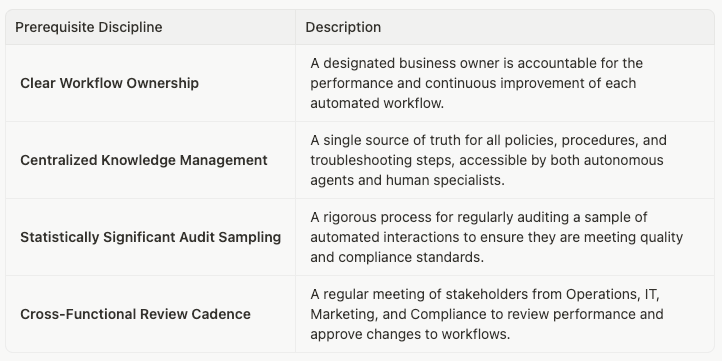
Leadership’s focus shifts from managing queues to managing the system, using data on repeat-demand, quality audits, and incident learnings to continuously refine and improve the automated workflows. Before an organization can scale to this level of transformation, it must standardize several key disciplines:
The Gozupees Approach: Autonomous Agents for Tier-Zero Support
The successful redesign of the customer service workforce hinges on deploying the right class of automation. The market is saturated with simple, rules-based chatbots that are fundamentally incapable of delivering the outcomes described in this playbook. These systems, which lack deep integration into core operational platforms, often create more frustration than they resolve, acting as little more than sophisticated IVR menus. Gozupees provides a different class of technology: autonomous voice agents designed specifically for the security, complexity, and scale of the telecommunications industry.
What Makes Autonomous Agents Different
It is critical for leaders to distinguish between chatbots and autonomous agents. A chatbot is designed to answer questions; an autonomous agent is designed to complete work. This distinction is not semantic; it is architectural.
- Direct OSS/BSS Integration: Gozupees agents connect directly to Operations and Business Support Systems via secure, managed APIs. This allows them to diagnose network issues, retrieve billing data, process service changes, and schedule appointments in real time, without requiring human intervention.
- Secure PII Handling: Our platform is architected from the ground up for the secure handling of Personally Identifiable Information (PII), with built-in controls for data masking, access logging, and compliance with all relevant privacy regulations.
- Multi-Step Workflow Execution: Unlike a chatbot that can only provide a single answer, a Gozupees agent can execute complex, multi-step workflows. For example, an agent can identify a billing discrepancy, retrieve the relevant usage data, apply a pre-approved credit, and confirm the resolution with the customer in a single, seamless conversation.
The Tier-Zero Support Framework
Gozupees enables a new operational layer we call Tier-Zero Support. This is a fully automated first point of contact that is capable of resolving up to 70% of all inbound call volume without human-in-the-loop intervention.
This is not call deflection; it is end-to-end resolution. By absorbing the high volume of repetitive, low-complexity inquiries, Tier-Zero Support fundamentally changes the structure of the contact center.
It frees human agents from the tyranny of the queue, allowing them to be re-tasked as the high-value Customer Success Specialists described earlier in this playbook. This framework also provides unprecedented resilience during peak events.
During a major service outage, a Tier-Zero system can handle a nearly infinite volume of concurrent inquiries, providing consistent, accurate status updates to every customer without the queue collapses that characterize legacy models.
Use Case Deep Dive: Service Outage Management
Consider the typical response to a large-scale service outage:
The Old Way:
The contact center is instantly flooded with calls. Wait times skyrocket from minutes to hours. Frustrated customers who finally reach an agent are given the same generic information that could have been provided automatically. Agent burnout spikes, and customer satisfaction plummets. The event is a net-negative for brand perception and customer loyalty.
The New Way with Gozupees:
The autonomous agent system immediately recognizes the spike in calls from a specific geographic area. It cross-references this with network monitoring data to confirm the outage.
When a customer from the affected area calls, the agent provides a proactive, personalized greeting:
“Hello, thank you for calling. We are aware of a service outage in your area affecting your internet and television services. Our engineering team is working on the issue and expects to have it resolved by 6:30 PM. Can I send you a text message with updates?”
The customer gets the information they need instantly, without waiting in a queue. The contact center is not overwhelmed, and human agents remain free to handle unrelated, complex issues.
Appendices
Appendix A: Glossary of Terms
- Autonomous Agent: An AI-powered system capable of executing complex, multi-step workflows by integrating directly with backend systems (e.g., OSS/BSS). Unlike a chatbot, which primarily answers questions, an autonomous agent completes work.
- BSS (Business Support Systems): The set of software applications that support customer-facing activities. This includes billing, order management, customer relationship management (CRM), and customer self-service portals.
- CES (Customer Effort Score): A customer experience metric that measures how much effort a customer had to exert to get an issue resolved, a request fulfilled, or a question answered.
- Chatbot: A software application used to conduct an online chat conversation via text or text-to-speech, in lieu of providing direct contact with a live human agent. Typically operates on a set of rules and keywords and lacks deep system integration.
- Confidence-Based Routing: A mechanism by which an autonomous system calculates a confidence score for a potential action or decision. If the score exceeds a predefined threshold, the system proceeds; if it falls below the threshold, the interaction is escalated to a human agent.
- FCR (First Contact Resolution): A contact center metric that measures the percentage of inbound inquiries that are fully resolved on the first attempt, without the customer needing to make a follow-up contact.
- Human-in-the-Loop: A model that combines human and machine intelligence, where a human agent is brought into an automated process at critical junctures, typically to handle exceptions, provide judgment, or approve a system-proposed action.
- IVR (Interactive Voice Response): An automated telephony system that interacts with callers, gathers information, and routes calls to the appropriate recipient. Static IVR systems use rigid, pre-programmed decision trees.
- OSS (Operations Support Systems): The set of software applications that a telecommunications service provider uses to manage its network and operations. This includes network monitoring, service provisioning, and fault management.
- PII (Personally Identifiable Information): Any data that could potentially identify a specific individual. Examples include name, address, phone number, and social security number. The handling of PII is governed by strict privacy regulations.
- Tier-Zero Support: A fully automated first point of contact, enabled by autonomous agents, that is capable of resolving a high percentage of inbound inquiries without any human intervention.
Appendix B: Data Tables & Financial Models
Cost Modeling Template: Annual Cost of Agent Turnover
References
[3] “Call Center Turnover Rates | 2025 Industry Average.” Insignia Resources, 28 June 2025,
[5] “Scaling the AI-native telco.” McKinsey & Company, 27 Feb. 2025,
Want to learn more?
Discover how GoZupees AI solutions can help your organization stay ahead of industry trends.