The math on seasonal staffing: why paying for idle capacity 8 months a year doesn’t make sense when…
A GZP Operator Playbook
The math on seasonal staffing: why paying for idle capacity 8 months a year doesn’t make sense when AI scales to zero
When demand swings hard, the cheapest “capacity” is often product fixes and automated resolution, not year-round headcount.
TL;DR
• “Staff for peak” often means buying idle seats for most of the year, then still scrambling during the true spike.
• The real unit of cost is cost per resolved issue, not cost per hour staffed. Idle time inflates it fast.
• Routine seasonal contacts are usually predictable and repetitive, which makes them the best target for automated resolution and better self-serve.
• Automation does not remove humans. It changes where humans spend time, pushing them toward exceptions, risk, and complex cases.
• The right model is a three-layer capacity stack: prevent demand, automate routine resolution, flex human staffing for the rest.
Start with the uncomfortable truth: most “seasonal staffing” is really “idle staffing”
Every seasonal operation knows the story. Demand spikes. Customers flood in. Wait times climb. Leaders approve hiring. Training runs late. The peak arrives anyway. Agents grind through it. Then the spike ends, volume drops, and a new problem appears.
The new problem is silence.
Rows of paid hours with not enough work. Supervisors invent projects. Coaches schedule extra calibrations. Quality teams add checklists. People browse internal pages and wait for tickets to arrive. The payroll line stays flat while the demand line falls off a cliff.
That gap is not a small inefficiency. It is the largest cost in many service orgs. It also hides behind a comforting idea: hire for peak, because the peak must be handled.
The peak does need coverage. The mistake is assuming the only way to cover the peak is to buy peak capacity all year.
Seasonal staffing is often treated like an operations craft problem. It is actually a math problem with clear inputs: demand volatility, service promises, fixed labor costs, variable labor options, and what share of work can be handled without a human at all.
Once those inputs are laid out, the old approach looks less like prudence and more like habit.
The core equation: capacity paid vs. capacity used
A contact center buys capacity in hours and spends it in effort.
That sounds obvious, but most planning mixes the two.
1. Paid capacity is the supply side:
- wages and benefits
- manager and support overhead
- training time
- shrinkage and absence
- tooling and licenses tied to seats
2. Used capacity is the demand side:
- effort minutes to resolve issues
- time spent on after-work and documentation
- rework from repeats and escalations
- time spent searching, switching tools, and waiting on approvals
Seasonality breaks the balance between the two.
When demand is high, used capacity is higher than paid capacity. Queues form and service slips.
When demand is low, paid capacity is higher than used capacity. Idle time forms and cost per resolved issue rises.
Most teams only feel the first part because it is loud. The second part is quiet and constant. Finance feels it every month.
A simple way to see it is utilization.
Utilization is not a goal. It is a signal.
If the operation must stay at 55–65% utilization for 8 months just to survive 2–4 peak months, then the business is buying a lot of insurance. Insurance can be sensible. It just needs to be priced like insurance, not hidden inside payroll.
This is where the conversation should move from staffing to economics.
The seasonal premium is larger than most leaders admit
Idle time is not free time. It carries hidden costs that stack.
• Payroll is only the start
Base wages are paid whether the work arrives or not. Benefits and taxes follow. Licenses often follow. Workspace costs may still follow even in hybrid models.
• Management overhead stays fixed
Team leads, supervisors, analysts, trainers, and QA staff do not scale down cleanly when volume drops. Their work shifts, but their costs remain.
• Quality and compliance risk rises in slow periods
Slow periods often create “busy work.” Busy work changes behavior. Agents handle fewer real contacts, so proficiency can drift. Then peak returns and error rates jump at the worst time.
• Attrition climbs for a different reason
In peak, people leave because it is too hard. In off-peak, people leave because it is too dull or because schedules feel pointless. Seasonal operations can manage this, but it takes effort. Idle staffing makes the problem worse.
• Training becomes a recurring tax
Hiring for peak often means training waves. Training is expensive and it lands at the exact moment the operation is already stressed. Then those newly trained agents sit underloaded for months.
The seasonal premium is not a moral issue. It is arithmetic. Paying for capacity that is not used will always raise cost per resolution.
So the question becomes practical: what is the cheapest way to cover peak without buying idle months.
The wrong comparison: humans vs. automation
The debate often gets framed as humans versus automation. That framing wastes time.
A better framing is fixed capacity versus variable capacity.
Humans can be fixed or variable depending on the staffing model. Automation is almost always variable once built.
The reason “automation scales to zero” lands is not because it is literally free. It is because the marginal cost of handling the next routine issue is close to zero compared to adding another staffed hour. The build cost exists. The governance cost exists. The maintenance cost exists. But the cost does not rise linearly with volume in the same way wages do.
That changes seasonal math.
If seasonal demand is mostly repetitive, then the best place to absorb the spike is the layer of the system whose marginal cost does not spike with it.
This is not about replacing people. It is about refusing to fund idle payroll as the default peak insurance policy.
A clean model: break demand into three buckets
Seasonal planning gets clearer when demand is segmented by what it needs.
Bucket 1: preventable demand
These are contacts caused by avoidable issues: unclear billing lines, confusing policy, broken tracking links, repetitive password resets, status questions that should be visible, and error messages that mean nothing.
Preventable demand is the cheapest to “staff” because the correct staffing move is to remove it.
Bucket 2: routine resolvable demand
These are contacts that do need service, but the resolution path is stable: order status, refunds with clear eligibility, appointment rescheduling, address changes, subscription changes, basic troubleshooting steps, and policy clarifications.
This bucket is where automated resolution and self-serve carry the most weight. It is also the bucket that grows sharply during seasonal events because the same issue hits many customers at once.
Bucket 3: judgment and exception demand
These are the cases that need empathy, discretion, negotiation, investigation, and risk checks. This is where humans remain essential.
Seasonal volume often grows most in bucket 2, not bucket 3. That is the key. If the spike is mostly routine, then paying for year-round human capacity is a costly way to cover it.
What “scales to zero” actually means in operating terms
The phrase can be grounded without hype.
Scaling to zero means:
- the system can handle 5x routine volume without 5x labor hours
- response speed does not collapse when volume spikes
- unit cost for routine resolutions stays roughly flat as volume rises
- humans get a cleaner queue of exceptions instead of drowning in status checks
This is not automatic. It only happens when workflows are designed for it.
The routine bucket must be:
- clearly defined
- policy-clean, with few edge cases
- supported by reliable data sources
- instrumented with a safe fallback to humans
When those conditions exist, the routine workload becomes a throughput problem that software handles well. The seasonal spike stops being a staffing emergency and becomes a monitoring exercise.
The staffing math that makes the case without ideology
Seasonal staffing is a cost curve problem.
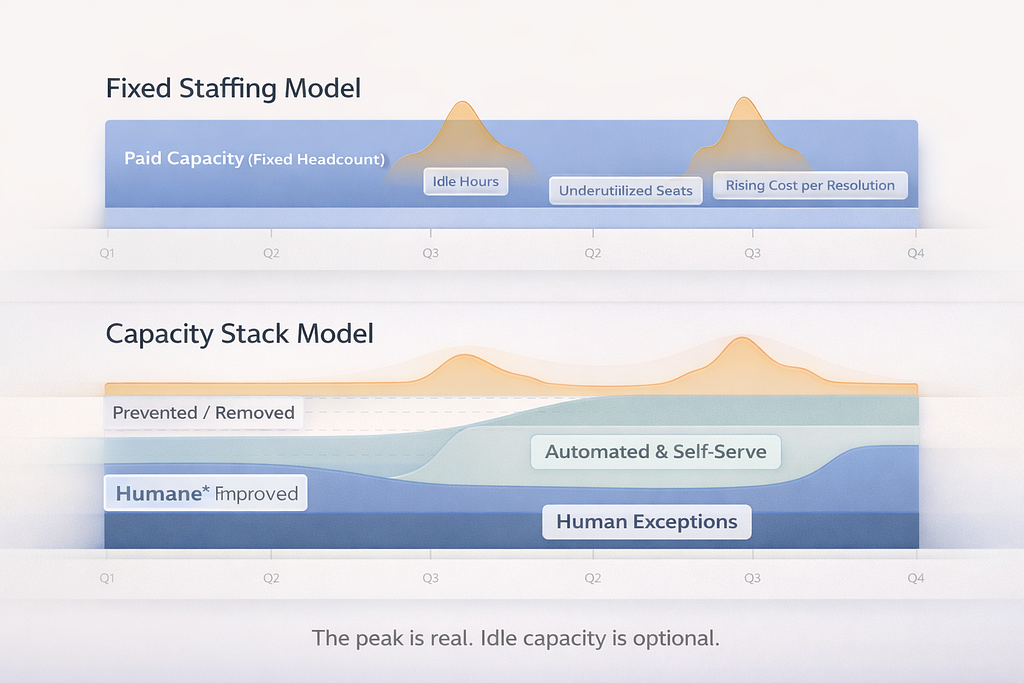
• Fixed staffing cost curve
Hiring full-time headcount creates a mostly fixed monthly cost. The curve is flat across the year.
• Seasonal demand curve
Demand is not flat. It spikes.
If the cost curve is flat and the demand curve spikes, then either:
- the business buys idle months, or
- the business fails the peak, or
- the business finds variable capacity
Variable capacity comes in several forms:
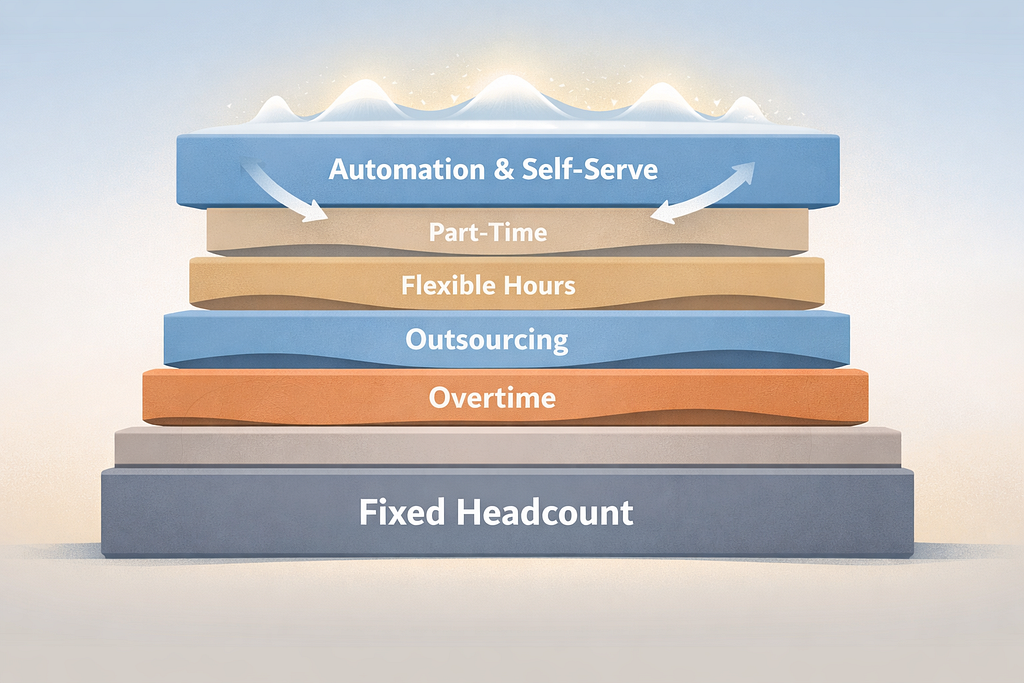
- part-time staffing that expands in peak windows
- flexible hour banks and annualized hours
- on-call coverage with clear pay rules
- outsourcing with tight governance
- overtime, used carefully as a short-term dial
- automation and self-serve for routine work
The modern answer is not “pick one.” It is “stack them.”
The main point is that automation changes the shape of the capacity stack. It can absorb a large share of bucket 2 work during peaks, which reduces how much human variable capacity is needed. That in turn reduces how much fixed headcount is justified.
The result is simple: less idle payroll, fewer emergency hires, and more stable service.
The common failure: building fixed headcount to cover unknowns
A lot of seasonal headcount is justified with fear.
Forecasts might be wrong. Marketing might run a promotion. Weather might disrupt deliveries. A release might break. A competitor might cause a surge. Leaders then choose the safest option: hire and hold.
The cost of that safety sits in idle months.
There is a better way to buy safety: create safety valves that do not require full-year payroll.
Safety valves that scale cheaply include:
- strong status transparency so customers do not need to ask
- clear proactive messaging during delays
- automated flows for routine changes
- dynamic deflection into self-serve for known spikes
- fast escalation paths for true exceptions
- flexible staffing pools that can be activated without long training
This is “capacity design,” not “staffing.” It treats the system like a set of dials, not a single headcount knob.
The governance reality: automated resolution needs controls like any other production system
No serious operator should pretend automated resolution is free. The right argument is that its marginal cost is low, not that its risk is low.
The risks are known and manageable:
- incorrect resolutions when data is wrong
- policy drift when rules change
- uneven handling of edge cases
- customer confusion when the handoff to humans is clumsy
- brand risk when tone and outcomes do not match expectations
These risks are not a reason to keep paying for idle payroll. They are a reason to govern the automated layer like any customer-facing production system.
A workable governance set usually includes:
- a clear scope: what the automated layer is allowed to complete
- versioned policies and decision rules
- monitoring on containment, re-contact, and escalation rates
- sampling and audits on outcomes
- a fast rollback path when metrics slip
- clear customer disclosure and easy access to a human for exceptions
This is the part many teams skip. Then the system underperforms and leaders go back to hiring. The lesson is not that automation failed. The lesson is that governance was missing.
The three-layer capacity stack that works in seasonal businesses
A stable seasonal model usually looks like this.
Layer 1: remove and prevent demand
This reduces the peak and raises satisfaction at the same time. It comes from:
- fewer broken flows
- clearer policies
- better in-app status
- fewer reasons to contact in the first place
Layer 2: automate routine resolution
This is the volume absorber. It handles bucket 2 at scale, especially in peak weeks. It needs strong data and clear rules.
Layer 3: flex humans around exceptions
Humans focus on bucket 3 and the edge of bucket 2. Capacity flexes through:
- cross-trained pools
- seasonal part-time shifts
- short-term contractors with tight scopes
- selective outsourcing with strict quality gates
- overtime as a short dial, not a permanent habit
This stack is logical because it matches cost structure to demand structure.
Preventable demand reduction lowers volume permanently. Routine automation absorbs spikes cheaply. Human flex handles what cannot be standardized.
In this model, fixed year-round headcount becomes the stable core for bucket 3 plus baseline bucket 2 exceptions. The peak no longer justifies a full-year payroll expansion.
The key metric: cost per resolved issue, not cost per contact
Seasonal operations often celebrate low cost per contact in off-peak months. That number can be misleading if contacts are low and idle time is high.
The metric that tells the truth is cost per resolved issue across the year.
When fixed staffing is too high, cost per resolved issue rises in off-peak months because paid capacity is not being converted into outcomes.
When routine work is automated, cost per resolved issue stabilizes because the cost of routine resolution does not rise linearly with peak volume.
A clean executive dashboard for this topic usually includes:
- total resolved issues per month
- total labor hours per month
- cost per resolved issue
- share of routine issues resolved without a human
- re-contact rate for automated resolutions
- backlog aging for the exception queue
These measures make it hard to hide idle cost behind alandar periods.
They also force the right tradeoffs. If automated containment rises but re-contact rises too, then the system is creating rework and must be fixed. If containment rises and re-contact stays flat, then the model is working and staffing can be reduced safely.
Address the objections that stall decisions
Seasonal leaders often share the same concerns. They are reasonable concerns. They just should not block the math.
“Automation is expensive to build”
Build cost is real. That is why the comparison should be against the annual idle payroll premium, not against zero. If idle months cost more than the build and governance over a year or two, then the decision is straightforward.
“Customers want humans”
Customers want outcomes. For routine work, speed and clarity often matter more than the channel. Humans remain vital for exceptions and judgment. The stack keeps humans where they add real value.
“Peak is when everything breaks”
That is true. That is also why the routine layer should focus on the most stable, data-backed tasks first. Peak breakage often comes from supply chain, outages, and policy edge cases. Those should route to humans fast. The automated layer should reduce load so humans can handle the breakage.
“Policy changes every week”
That is a governance problem. Version policies, test changes, and monitor outcomes. Frequent change is not a reason to fund idle payroll. It is a reason to treat policy like software that needs release control.
“Quality will drop”
Quality drops when the wrong work is automated or when escalation is blocked. Quality rises when routine work is handled consistently and humans get time for complex cases. The monitoring loop matters more than the idea.
None of these objections defeat the logic. They point to design requirements.
A practical way to run the numbers without making it complicated
Seasonal math can be done with a small set of inputs.
1. Identify peak months and baseline months :
Use last year’s demand pattern. Normalize for known changes. Do not overfit.
2. Estimate baseline human capacity needs for bucket:
Look at complex case volume and effort. This is the core that stays year-round.
3. Identify the top routine seasonal drivers:
Pick 10–20 drivers that explode during peak. These are the best targets.
4. Estimate how much of those drivers can be resolved without a human:
Start conservative. Focus on what has clear rules and good data.
5. Calculate avoided labor hours at peak:
This becomes the “peak headcount avoided” number.
6. Compare avoided cost against build and governance cost:
This is the breakeven view. It can be done in one page.
7. Decide what human flex is still needed:
Even with automation, peak will need flex humans for exceptions. Plan this with part-time pools, cross-training, and limited overtime.
The output is not a perfect model. It is a decision model. It shows whether year-round hiring is a rational insurance purchase or an expensive habit.
What changes inside the organization when this model is adopted
This shift is not only a cost move. It changes operating rhythm.
Forecasting becomes less fragile:
When routine volume spikes can be absorbed without linear labor growth, forecast error hurts less.
Hiring becomes calmer
Instead of a scramble to hire and train for peak, hiring focuses on core skills and long-term capability.
Training becomes higher quality
Training can focus on exception handling, policy judgment, de-escalation, and complex workflows, not on repeating routine scripts.
Product teams get clearer defect signals
When routine questions are reduced, the remaining contacts point more clearly to real product and policy problems.
Customer experience becomes more consistent
Seasonal peaks often create the worst service experiences. A scalable routine layer keeps response speed stable and reduces the “peak penalty” customers pay.
This is what “intelligent and logical” looks like in practice. It is not a slogan. It is a system that
The peak is real, but the idle payroll is optional
Seasonal demand swings will not disappear. The business still needs to handle peak volume. The argument here is narrower and more practical.
Paying for idle capacity 8 months a year is a costly way to buy peak coverage when a large share of peak work is routine and repeatable. The marginal cost of resolving that routine work can be near zero once the system is built and governed. That changes the economics.
The sensible move is not to bet everything on one approach. The sensible move is to build a capacity stack: remove preventable demand, automate routine resolution, and flex humans for exceptions.
That stack does not just reduce cost. It reduces chaos. It turns seasonal planning from a yearly panic into a controlled design problem with clear dials.
That is what makes the math worth doing.
The math on seasonal staffing: why paying for idle capacity 8 months a year doesn’t make sense when… was originally published in GZP Blog on Medium, where people are continuing the conversation by highlighting and responding to this story.