The 10x knowledge worker: one expert + AI can handle the query volume of 10 average agents
A GZP Operator Playbook
The 10x knowledge worker: One expert + AI can handle the query volume of 10 average agents
The claim holds in the right conditions, but the conditions matter more than the tools.
TL;DR
• “10x” is achievable in specific work types when an expert uses an assist layer to draft, retrieve, and route, while the expert makes the final call.
• The real win is less rework: fewer wrong answers, fewer escalations, fewer callbacks, fewer reopened cases.
• This only works with tight scoping: clear decision rights, strong knowledge, good data access, and safe fallbacks.
• Without governance, the model creates hidden risk: inconsistent advice, policy drift, and quiet compliance failures.
• The clean way to prove it is to measure cost per resolved issue, reopen rate, time-to-resolution, and error impact, not just “tickets closed.”
Start with what “10x” actually means in operations
The phrase “10x knowledge worker” gets thrown around like a personality trait. It is not a trait. It is an operating design.
In service and operations, output is rarely limited by typing speed. Output is limited by avoidable rework, slow retrieval of context, and decision risk. A “10x” setup is one where those limits are systematically reduced, so one expert can produce correct outcomes at a rate that used to require a small team.
That also means “10x” should not be measured as “ten times more messages sent.” It should be measured as ten times more issues resolved without creating more downstream clean-up.
The claim that one expert plus an assist layer can handle the query volume of ten average agents can be true, but only when the work has three properties:
- The questions repeat in recognizable patterns
2. The answers are constrained by policy, product state, and data
3. The business can define what “correct” looks like
When those are true, the assist layer can do the first 80% of the work: gather context, draft a response, cite the policy snippet, propose the next step, and identify missing fields. The expert then does the last 20%: verify, decide, and take accountability.
That division of labor is the core idea. Everything else in this blog is the practical work needed to make that safe and repeatable.
The real bottleneck is not volume. It is variance.
Most teams staff for average demand and then struggle in two places:
- Peaks in volume
- Long-tail complexity
The long tail is where the expert lives. It is also where most teams spend their time without realizing it, because “average agents” get pulled into complex work they are not set up to close. They escalate. They ask for help. They reopen cases. They wait on approvals. Customers return. Volume grows.
In that environment, adding more average agents does not scale linearly. It often scales rework.
A single expert can look like ten average agents because the expert reduces variance:
- Faster diagnosis
- Fewer wrong paths
- Better use of partial information
- Better judgment on exceptions
- Better routing of what truly needs specialist attention
The assist layer then amplifies that expert advantage by removing the repetitive parts that steal expert time: searching, summarizing, drafting, and formatting.
So the math is not magic. It is variance reduction plus faster context assembly.
Why average teams struggle: the hidden cost of “figuring it out”
Most knowledge work looks simple from a distance. A ticket arrives. Someone answers. Case closed. In practice, the work is a chain of micro-steps:
- Read the inbound message
- Find the right account or record
- Understand recent history
- Recall the relevant policy
- Check edge-case rules
- Compose a response that is accurate and clear
- Execute the workflow steps in tools
- Record notes so the next person can continue if needed
Average agents do these steps with high friction. The friction is not their fault. The friction is structural.
Common friction points include:
- Knowledge content is long, duplicated, and out of date
- Policies change and updates do not reach the floor
- Tools are slow and data is fragmented
- Templates exist but do not match real cases
- Escalation paths are unclear
- Decision rights are narrow, so the agent cannot finish
Each friction point increases handle time, but the bigger damage is error. Errors create follow-ups. Follow-ups create new tickets. The queue becomes a recycling machine.
Experts still feel the friction, but they navigate around it faster, and they make fewer high-impact mistakes. When an assist layer absorbs retrieval and drafting, the expert spends more time on the parts that require judgment, not on the parts that require searching.
That is where the 10x effect is born.
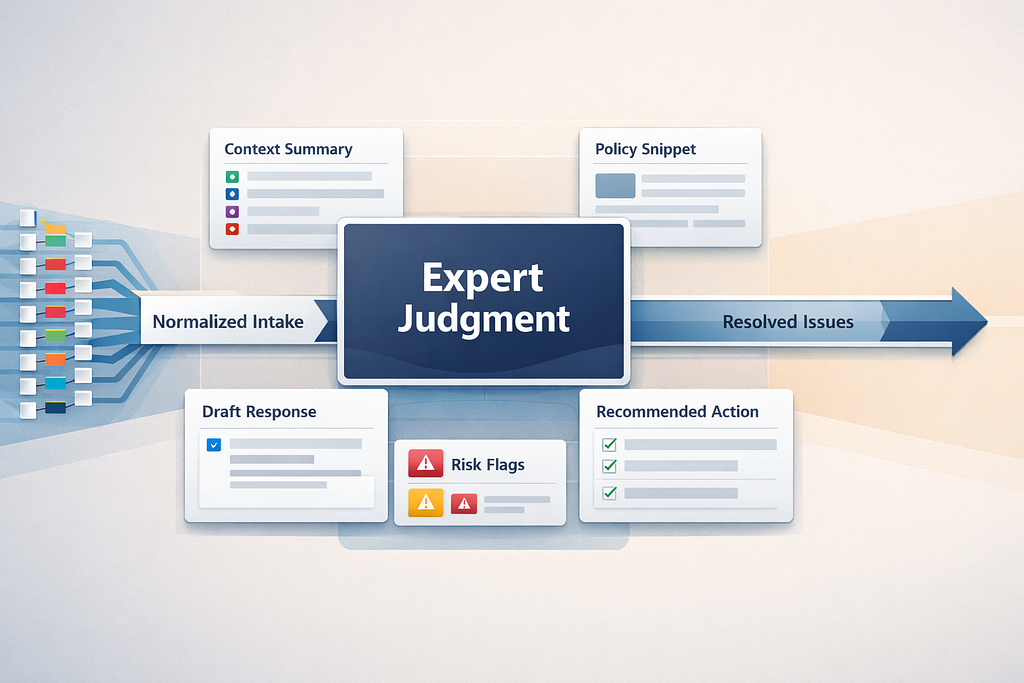
The assist layer does four jobs that change throughput
To make this concrete, the assist layer is not “a bot that answers customers.” In the best setups, it is a co-pilot for the operator.
It does four jobs.
1) Intake and normalization
Most queries arrive messy: missing order IDs, unclear symptoms, partial screenshots, mixed topics. Humans waste time asking for basics.
The assist layer can standardize intake:
- Detect topic and subtopic
- Pull required fields
- Prompt for missing information
- Attach relevant account context
- Flag risk markers like chargebacks, regulated terms, or VIP status
The output is a structured case packet. The expert starts with a clean summary rather than a puzzle.
2) Retrieval and grounding
Knowledge work is rarely “think from scratch.” It is “apply the right rule to the right context.”
The assist layer can retrieve:
- The relevant policy section
- The current product state or incident status
- Known-issue notes
- Similar past cases and outcomes
- The correct workflow steps
This reduces search time and reduces the chance of using an outdated doc.
3) Drafting the response and the workflow plan
Drafting matters because it is time-consuming and repetitive.
The assist layer can draft:
- Customer-facing response in the correct tone
- Internal notes with key fields
- A recommended action plan: refund path, replacement steps, escalation route
- A checklist of required compliance steps
The expert then verifies and edits instead of starting from a blank page.
4) Routing and escalation packaging
Escalations are expensive mainly because they are poorly packaged. The specialist receives a vague ticket and has to start over.
The assist layer can package escalations with:
- A crisp problem statement
- What has already been tried
- Logs, screenshots, and account state
- The specific decision needed from the specialist
- The customer promise and deadline
That makes the specialist faster and reduces bounce-backs.
Put together, these four jobs can reduce per-case effort dramatically, especially for repetitive categories.
When “one expert = ten average agents” is most likely to be true
The 10x claim does not hold evenly. It concentrates where there is repeatability and policy constraint.
It tends to work best in these situations:
- Tier two desks that answer repeated “how do we handle this” questions
- Operations support for internal teams: billing, provisioning, access, fulfillment
- Incident-driven support where known issues generate waves of similar tickets
- Compliance-heavy workflows where checklists and templates matter
- Customer support categories where the fix is a stable playbook
It works poorly where the work is truly bespoke:
- Novel engineering investigations with sparse signals
- High-stakes decisions with ambiguous policy
- Negotiation-heavy retention work where the goal is not binary
- Cases where the underlying data is missing or unreliable
In other words, the model scales when the system can define and enforce “the right way to do it.”
The overlooked driver of 10x output: fewer reopenings
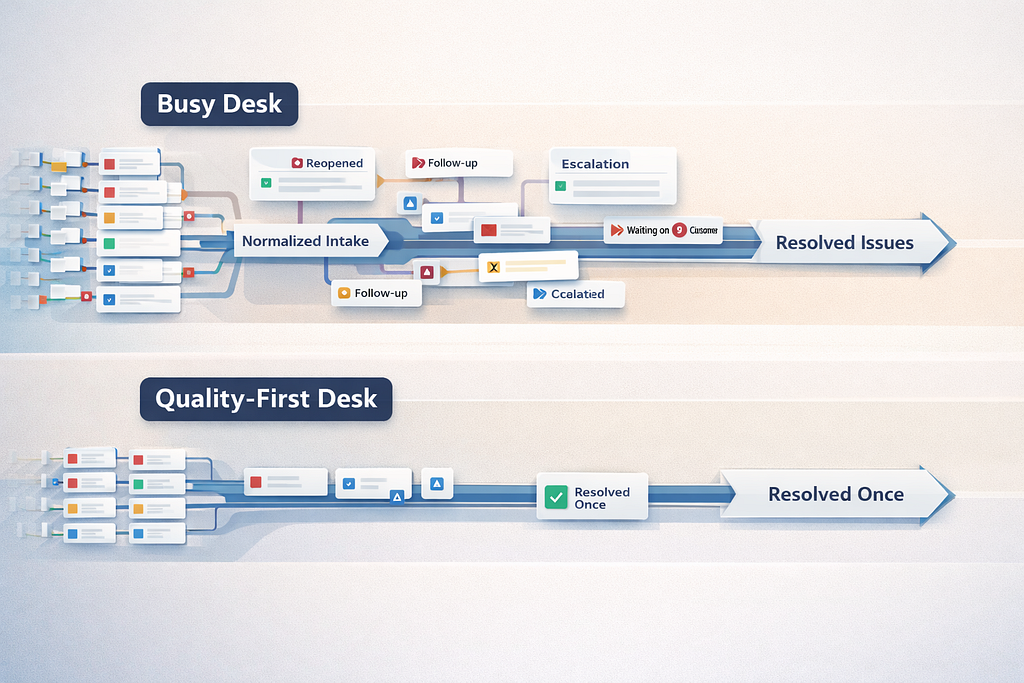
Most leaders look for speed gains. The bigger gain is quality.
A desk can feel busy and still produce low throughput because so much of the workload is rework. Reopenings, follow-ups, “checking in” contacts, and escalations are all forms of rework.
An expert plus an assist layer reduces rework in three ways:
- The first answer is more likely to be correct
2. The response is more complete, reducing the need for clarification
3. The workflow steps are followed consistently, reducing downstream breakage
If reopen rate drops from 20% to 8%, the desk has effectively created capacity without hiring. That is why a single expert can “handle” more volume. The desk is not just moving faster. It is producing fewer future tickets.
This is also why a team can add headcount and still feel underwater. If quality is low, the system produces demand faster than it resolves it.
The workflow that makes the expert desk run like a production line
A 10x setup needs a repeatable daily rhythm. The rhythm is what turns potential into throughput.
A practical workflow looks like this:
Step 1: Triage packets, not raw messages
Cases arrive as structured packets with topic, key fields, and a proposed action.
Step 2: Expert makes the decision, not the draft
The expert reviews the packet, checks the retrieval snippet, edits the draft if needed, and decides.
Step 3: Execution happens in one place
The workflow steps are executed with a checklist. If the tools require three systems, the checklist reduces missed steps.
Step 4: Close with a prevention tag
Every case is tagged with a driver: policy confusion, product defect, tooling gap, customer education. These tags become the input to a weekly demand-reduction loop.
Step 5: Sample audits replace blanket QA
Instead of grading every case lightly, audit fewer cases deeply, focusing on high-risk categories and high-dollar impact.
This rhythm is calm and predictable. It is how high output stays stable.
The economics: what “10x” does to cost per resolved issue
The business case should be written in unit economics, not in slogans.
The baseline model in many centers looks like this:
- average agent handles X cases per day
- a portion reopen
- a portion escalate
- each escalation consumes specialist time
- customer repeats create additional contacts
So the real cost per resolved issue includes:
- frontline time
- specialist time
- supervisor time
- rework time
- credits and concessions tied to errors
A 10x expert desk changes the equation by reducing the “tax” terms:
- less reopen work
- fewer escalations that bounce back
- fewer concessions from delays
- fewer repeat contacts
Even if the expert is paid more than an average agent, the system can still be cheaper because it produces fewer total labor hours per resolved issue.
This is also where leadership alignment becomes easy. Finance does not need to believe in “10x people.” Finance needs to see cost per resolved issue drop while risk stays controlled.
What breaks the 10x model, and how to spot it early
There are predictable failure modes.
1. Knowledge debt
If the knowledge base is inconsistent, the assist layer will draft inconsistent answers. The fix is to clean and version the knowledge, not to push agents harder.
2. Tool fragmentation
If critical data is missing or split, the assist layer cannot assemble context. The expert spends time hunting. Output drops.
3. Policy ambiguity
If policies rely on “use judgment” without guardrails, consistency suffers. The expert becomes a bottleneck for every edge case.
4. Bad routing
If the expert desk receives too much baseline work, it will drown. The intake filter must protect the expert’s time.
5. No feedback loop
If errors do not feed back into templates and knowledge updates, the system does not improve. It becomes a faster way to repeat mistakes.
These can be detected early with a small set of signals: rising reopen rates, rising escalations, increased “manual research” time, and longer cycle time despite faster first responses.
Common concerns
This topic always triggers a few predictable reactions. They deserve straight answers.
Some leaders worry the expert desk will become a single point of failure
That risk is real if the desk is built around one person. The mitigation is a bench plan: rotate coverage, document decisions, and train two additional specialists. The assist layer helps that training, but it does not replace it.
Some leaders worry quality will drop
Quality drops when the system drafts confidently in areas where it should defer. The solution is scope control, audits, and clear fallbacks. Done well, quality usually rises because answers become more consistent and complete.
Some leaders worry this will cause layoffs or morale issues
The operational reality is that most centers are already capacity constrained in complex work. The model shifts humans toward higher judgment work, reduces burnout from repetitive tickets, and can reduce the need for seasonal hiring spikes. Headcount decisions should be made transparently, but the day-to-day effect is usually a better allocation of human effort.
Some leaders say their work is too complex for this
Some categories are too complex. That is why segmentation matters. The pilot should start where rules are clear and data is reliable. The model is not all-or-nothing.
10x is a system, not a slogan
One expert plus an assist layer can handle the query volume of ten average agents in the right conditions. The conditions are not rare, but they are specific: repeatable patterns, clear policies, good data access, and strong governance.
The biggest gain is not speed. The biggest gain is fewer mistakes and less rework. That is what creates true capacity.
The operator takeaway is simple. Build the operating system first: structured intake, reliable retrieval, drafted responses, clean decision rights, audits, and a bench. Then the expert becomes a multiplier rather than a bottleneck.
That is what a 10x desk looks like in the real world. It looks like fewer handoffs, fewer reopenings, and a steady flow of correct decisions.
The 10x knowledge worker: one expert + AI can handle the query volume of 10 average agents was originally published in GZP Blog on Medium, where people are continuing the conversation by highlighting and responding to this story.