Before You Deploy a Voice AI Agent: The 6-Point Success Readiness Checklist
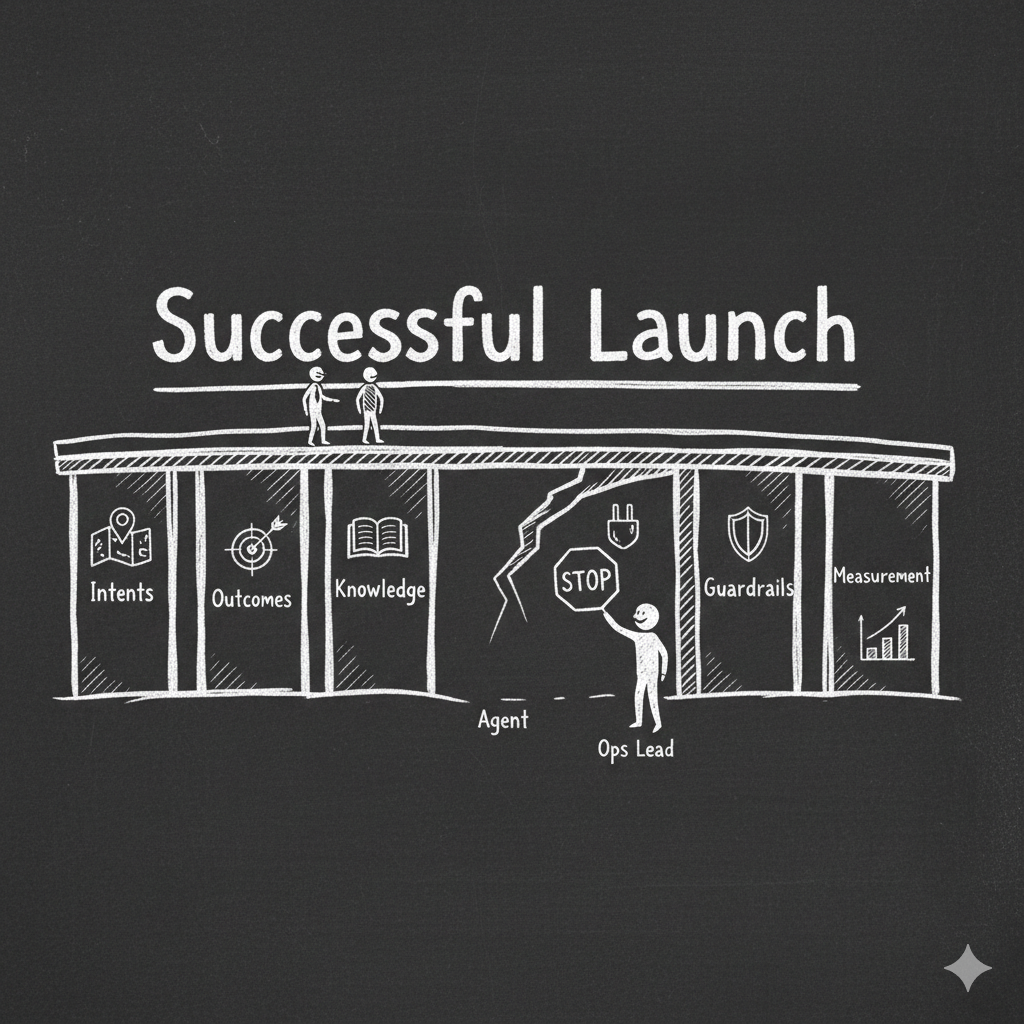
A build-ready checklist for intent, outcomes, knowledge, guardrails, integrations, and measurement.
TL;DR
- Lock the top 10–20 intents and define what the agent must not handle.
- Write business outcomes per intent, not vague “deflection.” Tie each call to a commercial result.
- Build a single source of truth and remove contradictions before training.
- Put guardrails + fast escalation in place, including “stop guessing after two misses.”
- Design integrations with a read-before-write rule and a latency budget.
- Launch only with measurement: containment, AHT, CSAT, task completion.
Why voice agents fail before build
Most teams do not fail on speech quality. They fail on basic operations.
A voice agent can sound natural and still be unhelpful. The agent can pronounce things wrong, misunderstand product names, or miss short forms. That is annoying, but it is not the main risk. The bigger risk is that the agent speaks clearly while doing the wrong thing.
When internal process is unclear, the agent does not fix it. The agent repeats it faster. The documented process is treated as truth, even when it is outdated. The handoff path is missing, so the agent keeps talking when it should stop. The system data is not connected, so the agent guesses. These are planning failures, not model failures.
The document is blunt on the root cause. Most failures happen before code. The usual drivers are poor data, bad process, or weak integration planning.
That framing matters because it changes what “ready” means.
“Ready” does not mean a demo answers a few FAQs. “Ready” means the call paths are bounded, the knowledge is controlled, the handoff is rehearsed, the systems are connected safely, and success is measurable. The rest is tuning.
The six pillars below are the practical way to check readiness. They are also a clean way to tell stakeholders “not yet” without getting stuck in taste arguments.
The 6-pillar readiness checklist (and what “done” looks like)
The six pillars are:
- Intent mapping
- Business outcomes
- Knowledge sources
- Escalation/guardrails
- Integrations/data
- Measurement.
Each pillar has a simple “done” definition, a set of artifacts, and a few failure modes to watch.
Pillar 1: Intent mapping that matches real call drivers
A voice agent needs boundaries. The fastest way to break it is to load it with everything.
The document gives a clear limit: identify the top 10 to 20 reasons customers call. Do not build beyond that. Even 20 is a stretch.
This is not a product constraint. It is an operations constraint. Past that point, coverage becomes shallow, and the agent starts to guess.
Done looks like
- A ranked list of the top 10–20 intents, sourced from call logs, transcripts, and tickets, not from opinions. For each intent: a plain definition, entry criteria, and exit criteria.
- A “what success means” line per intent. Example: “order status delivered with tracking link,” or “appointment booked,” or “warm transfer with context.”
- A “do not handle” list, written down and agreed. VIP, sensitive topics, complex complaints, multi-system issues, legal threats, self-harm cues, and any regulated workflows belong here.
- An utterance library per intent. Customers often do not say the label of the issue. They describe symptoms (“can’t log in”) that still map to the intent (“password reset”).
- A useful pattern here is splitting intents across agents when scope grows. Technical support and billing are different worlds. The document calls out separate agents for separate scopes as a practical move.
Artifacts to require before build
- Intent map (10–20), with volumes and seasonality notes.
- Utterance set (minimum 20–50 per intent to start).
- “Not handled” policy with handoff paths.
Pillar 2: Business outcomes that pay for the work
Many teams set “call deflection” as the goal. That is a metric, not an outcome.
Outcomes are what changes the business. The document pushes teams to define outcomes beyond cost reduction and to tie calls to commercial value. It also frames a practical triangle: speed, accuracy, and experience. Sacrificing one breaks the others.
Done looks like
- A one-page outcome statement per intent. Not a slogan. A measurable change.
- A “good call” definition that includes both customer result and business result. The document gives examples like sale, solved ticket, retained customer.
- A cost model that includes more than agent minutes. Include recontacts, escalations, refunds, and compliance costs.
- A risk statement. Some intents are high brand risk. Those need stricter gates and faster escalation.
This is also where leaders can stop the “feature chase.” The agent speaking in many accents is not an outcome. It is an input. The outcome is whether the call ends with the right resolution and no repeat contact.
Artifacts to require before build
- Outcome map tied to intents (with owners).
- Target ranges (not single numbers) for speed, accuracy, and experience.
- A list of intents that are “assist-only” at launch.
Pillar 3: Knowledge sources that are controlled, current, and tagged
A voice agent will repeat whatever it is given. It will also repeat contradictions.
The document asks teams to identify where information lives (FAQs, CRM notes, PDFs, intranet pages, docs) and to surface contradictions such as “PDF says yes, website says no.”
It also stresses condensation and tagging. A long support book is rarely fit as-is. One practical suggestion is condensing a 50-page support hub into a smaller set of Q&A items and tagging them so the agent can retrieve the right slice fast.
Done looks like
- A declared source of truth per topic, with an update owner and cadence.
- A contradiction log with closures, not just findings.
- Answer policy: what must be quoted exactly vs what can be summarized.
- Explicit exclusions: topics the agent must avoid discussing. This often includes pricing exceptions, discount vouchers, and legal commitments.
- A tagged KB structure that maps to intents and sub-steps, not to org charts.
Knowledge work feels slow because it is. It is also the cheapest place to fix the agent. Fixing knowledge after launch shows up as repeat calls, escalations, and brand damage.
Artifacts to require before build
- Knowledge inventory with owners, freshness dates, and priority.
- KB in the chosen format (Q&A works well for many call types), with tags.
- Exclusion list and disclaimers that must be spoken.
Pillar 4: Escalation and guardrails that are fast and practiced
A good voice agent stops talking at the right time.
The document is direct: escalation and guardrails are required, including real-time escalation for self-harm or serious legal problems.
It also gives operational triggers: anger, frustration, repeated “no,” and the “I don’t know” loop. A practical rule appears: if the agent fails a confidence threshold twice, stop guessing and transfer to a human.
Done looks like
- A guardrail spec with triggers and actions (transfer, end call, create ticket, route to specialist).
- A maximum number of turns in a failing loop (three is a common ceiling in the document).
- A handoff design that avoids customer repetition. The document calls out an “anti-repeat rule” so the customer does not repeat name and problem.
- A warm transfer script and a short transfer summary (around 30 seconds) so the human starts with context.
- A privacy and identity check policy aligned to the intent (especially for account access workflows).
Guardrails are not only about safety topics. They are also about customer patience. Repeating the same question three times will drive escalations even when the answer exists.
A voice channel is less forgiving than chat because it is harder to skim, scroll, or copy details.
Artifacts to require before build
- Escalation matrix (intent x trigger x route).
- Transfer scripts and summaries.
- Red-team scenarios for sensitive flows.
Pillar 5: Integrations and data with “read before write” discipline
A voice agent without data becomes an answering machine.
The document uses a clean rule: read before write. Identify the caller, look up CRM, check status, then speak a personalized response. Only then consider write actions like updating CRM or creating a ticket.
It also states a safety gate: never let the agent write or change data until identity and status are read and verified.
Done looks like
- A system map for each intent: what data is needed, where it lives, and what permission level is required.
- Read-only access at launch for most systems, unless write is essential.
- Identity verification steps tied to the intent and data sensitivity.
- A latency budget and test plan. The document calls out API delays and suggests testing each function, with backend responses targeted under 200ms for a smooth experience.
- Failure modes: what the agent says when data is missing, stale, or blocked.
Integration planning is where many projects quietly die. Not because it is impossible. Because the org cannot agree on who owns the CRM fields, who approves permissions, and who supports the integration when it fails at 2 a.m.
Artifacts to require before build
- Integration requirements per intent (read/write, fields, systems).
- Access approvals and audit logging plan.
- Latency and failure testing results.
Pillar 6: Measurement that matches reality, not demos
If success is not measured, the rollout becomes opinion-driven.
The document lists practical measures: containment rate, average handling time, CSAT, and task completion. It defines containment in an operator-friendly way: the customer’s problem is solved and they do not call again within a set period (24 hours, 3 days, 7 days, 30 days, depending on the business).
It also sets a target: containment above 85%. And it suggests the agent should generally not run long calls, often around three minutes, with three to seven minutes as a workable range in many cases.
Done looks like
- A measurement plan that starts on day one, not after complaints show up.
- Clear definitions:
- Containment window by intent.
- What counts as an escalation.
- What “task completed” means for each intent.
- A QA loop that turns failures into KB fixes, routing changes, or integration work. The document describes using evaluations to find gaps in knowledge, data, and integrations, then expanding scope based on evidence.
- A small, steady release cadence. Voice agents improve through disciplined iteration, not big bangs.
Artifacts to require before build
- Metric definitions and dashboards.
- Sampling plan for call review and labeling.
- A weekly ops review agenda with owners for fixes.
Common traps that block a safe launch
The checklist above sounds straightforward. The traps are what make it hard.
Trap 1: Too many intents, too early
When scope expands, quality drops. Teams add intents to satisfy internal stakeholders, not because call data supports it. Then the agent covers everything poorly.
A hard cap forces prioritization. The document’s guidance to stay within 10–20 intents is the simplest control here.
A practical workaround is “two agents, two lanes.” One for billing. One for technical. That keeps knowledge smaller and integrations cleaner.
Trap 2: Weak knowledge base and no ownership
When knowledge is spread across PDFs, intranet pages, and tribal memory, the agent will reflect that chaos. Contradictions become customer-facing. Compliance statements get skipped. Policies become “maybe.”
The document calls out conflicting sources directly (PDF vs website) and the need to decide what is current before launch.
Ownership fixes this. Each topic needs an owner who can say “this is the approved answer” and update it on a cadence. Without that, every poor answer becomes an escalation, and every escalation becomes a debate.
Trap 3: No integration plan, then surprise latency
Many teams build the conversation first, then bolt on systems. That is backwards. The first question is what the agent must know before it speaks.
If the agent cannot identify the caller, it cannot personalize or act. If it cannot check order status, it cannot resolve. Then the agent fills the gaps with general advice, and callers bounce.
The read-before-write rule prevents a lot of damage. It also keeps permissions tight early on.
Latency is the second surprise. Slow APIs turn a clean dialogue into awkward silence. The document’s point about latency budgets and testing each function is not optional work.
Trap 4: Guardrails exist on paper, not in routing
It is easy to write a policy that says “escalate on legal threats.” It is harder to make that happen reliably at runtime, with the right routing and context.
Guardrails must be testable. The “two misses then transfer” rule is testable. The “three turns max in a failing loop” rule is testable. Warm transfer with a short summary is testable.
When these are not test cases, they become hopes. Hope is not a launch plan.
Trap 5: No measurement, so every argument is vibes
Without metrics, a rollout becomes a fight between the demo crowd and the support floor. Neither side is fully right because neither side can quantify.
Containment, AHT, CSAT, and task completion create a common language. The containment definition with a window also prevents gaming. A call is not “contained” if the same customer calls back tomorrow.
A simple go/no-go scoring rubric
This rubric is meant to block risky launches and speed up safe ones. It is not a maturity model. It is a gate.
Score each pillar from 0 to 2.
- 0 = Not ready
- 1 = Partially ready
- 2 = Ready
Pillar 1: Intent map
- 0: Intents are guessed or exceed 20. No utterance library.
- 1: Top intents exist but are not backed by call data or lack clear boundaries.
- 2: Top 10–20 intents backed by logs, success defined per intent, “not handled” list, utterances documented.
Pillar 2: Outcomes
- 0: Goal is “deflection” with no commercial definition.
- 1: Outcomes exist but not tied to intents or owners.
- 2: Outcome per intent with targets for speed/accuracy/experience and a “good call” definition.
Pillar 3: Knowledge
- 0: Knowledge is scattered; contradictions unknown.
- 1: KB exists but owners and exclusions are unclear.
- 2: Single source of truth by topic, contradictions resolved, exclusions set, KB condensed and tagged for retrieval.
Pillar 4: Guardrails and escalation
- 0: Escalation is “we will handle it” with no triggers.
- 1: Triggers exist but routing and handoff are not tested.
- 2: Triggers include sentiment loops and out-of-scope, “two misses then transfer,” warm transfer summary, anti-repeat rule.
Pillar 5: Integrations and data
- 0: No system access plan; agent will guess.
- 1: Read access exists but latency and failure paths are unclear.
- 2: Read-before-write is enforced, identity checks defined, permissions approved, latency tested per function.
Pillar 6: Measurement
- 0: No dashboard or definitions.
- 1: Metrics exist but not tied to intents or review cadence.
- 2: Containment definition and window, AHT, CSAT method, task completion per intent, weekly review owners.
Go / No-Go rule
- Go: Total score ≥ 10 and no pillar scored 0.
- No-Go: Any pillar scored 0, or total score ≤ 9.
- Conditional Go: Score 10–11 with a written mitigation plan and limited rollout scope (fewer intents, tighter hours, higher human coverage).
This gate prevents the most common failure mode: launching with great speech and weak operations.
How to use this checklist during rollout
Use the checklist twice: once before build, once before launch.
Before build, the checklist drives discovery work. It turns a vague goal into a bounded plan. It also keeps stakeholders aligned. When someone asks for “one more feature,” the answer becomes “which pillar does it improve, and what evidence supports it.”
Before launch, the checklist becomes a release gate. If guardrails are untested, it is a no-go. If the KB has unresolved contradictions, it is a no-go. If the integration path is slow, it is a no-go.
This is also the place to keep launch scope small. Limit hours. Limit intents. Keep a human floor ready. Then expand based on containment and task completion, not based on confidence.
A voice agent is not a website page. It talks to customers. That puts it closer to frontline staff than to software. Frontline work needs tight scripts, tight handoffs, and clear escalation. The six pillars are the minimum structure that makes that possible.
Before You Deploy a Voice AI Agent: The 6-Point Success Readiness Checklist was originally published in GZP Blog on Medium, where people are continuing the conversation by highlighting and responding to this story.